The allure of a "$49 Online Will" is tempting. In an age where we can diagnose our own coughs on WebMD and fix our own sinks via YouTube, why not draft our own estate plans?
However, in Texas, the "Do-It-Yourself" (DIY) approach to wills and trusts is often a siren song that leads straight to a courtroom. Because Texas has unique, strict, and recently updated probate laws, a single missed signature or an "almost-correct" form can cost your family tens of thousands of dollars in legal fees to fix later.
Here is why your DIY estate plan might be a ticking time bomb in the Lone Star State as of 2026.
________________________________________
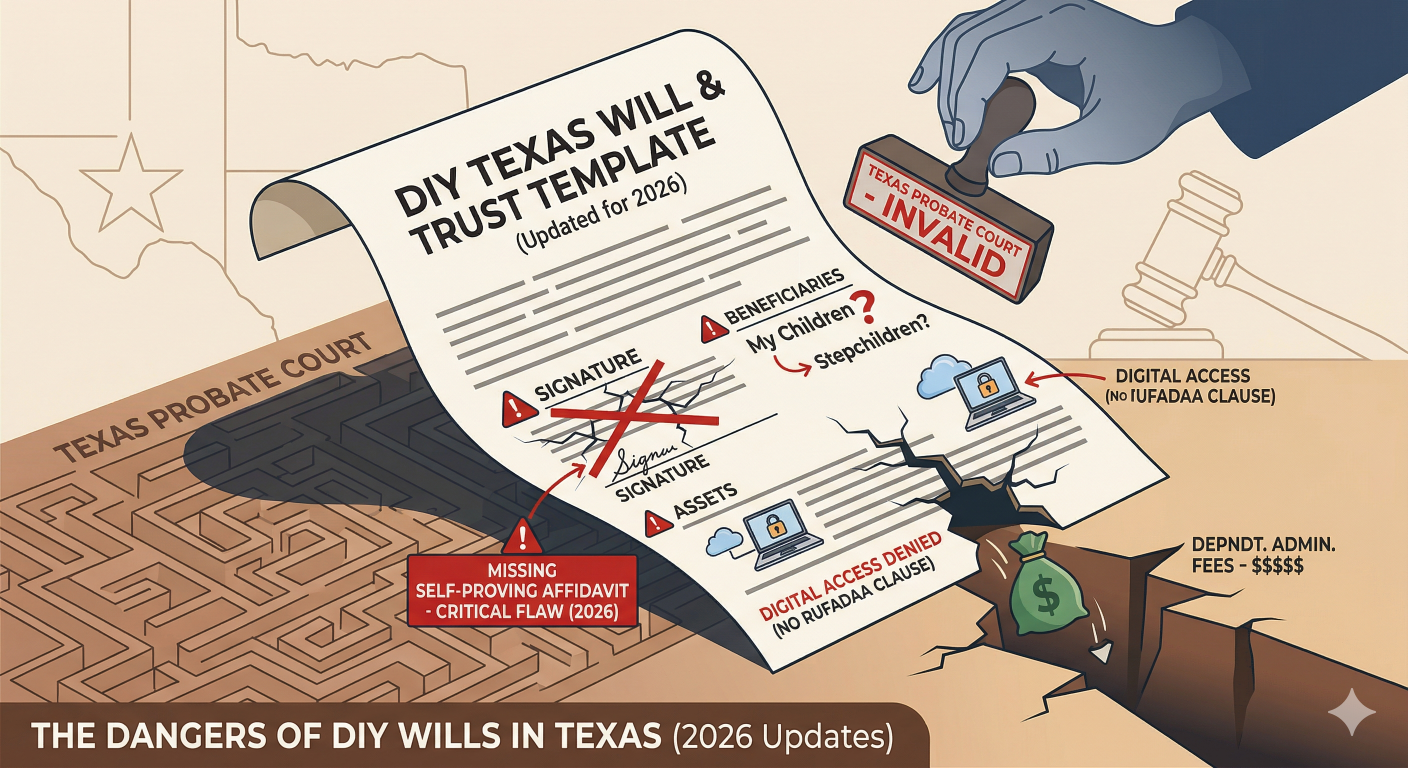
In Texas, a will doesn't just need to be signed; it needs to be "Self-Proved." Most DIY kits include a signature line for you and two witnesses. However, they often skip the specific Self-Proving Affidavit required by the Texas Estates Code.
• The Danger: If your will isn't self-proved, your executor must track down your witnesses years (or decades) later and bring them into court to testify that they saw you sign it.
• The 2026 Reality: While 2025's SB 1448 made it slightly easier to use a copy of a will if it has a self-proving affidavit, if you miss the affidavit entirely, your family is stuck in a procedural nightmare.
Texas is one of the few states that recognizes Holographic Wills—wills written entirely in your own handwriting. While they are "legal," they are the most frequently contested documents in Texas probate courts.
• The Risk: To probate a handwritten will, the court often requires two witnesses to testify that the handwriting is actually yours. If no one can testify, or if a disgruntled relative claims it's a forgery, your estate will have to hire expensive handwriting experts.
• The "Hybrid" Mistake: Many people use a printed template and fill in the blanks by hand. In Texas, if the material provisions are a mix of typing and handwriting, the court may reject the document entirely.
Many Texans create "Revocable Living Trusts" to avoid probate. But a trust is like a bucket: it only works if you put things into it.
DIY users frequently fail to "fund" their trusts. They sign the document but never legally transfer their home deed or bank accounts into the trust's name. In Texas, if your house isn't in the trust, your family still has to go through probate.
Pro Tip: As of 2025, Texas law requires very specific language in trust documents to maintain your Homestead Tax Exemption. Many generic online forms lack this, meaning your property taxes could skyrocket the moment you move your home into a DIY trust.
Texas intestacy laws (what happens if your will is declared invalid) are notoriously complex regarding blended families.
• The DIY Error: Generic forms often use the term "my children." In Texas, this typically does not include stepchildren unless they were legally adopted.
• The Consequence: If your DIY will is thrown out, your assets might be split between your current spouse and your biological children in a way that forces the sale of the family home—leaving your stepchildren with nothing.
We live our lives online, but most DIY templates are stuck in 1998. Texas recently updated the Revised Uniform Fiduciary Access to Digital Assets Act (RUFADAA).
If your estate plan doesn't include specific "Digital Power" language for 2026—covering everything from Bitcoin wallets to monetized social media accounts—your executor may be legally barred from accessing them, even with a death certificate in hand.
________________________________________
Feature DIY Will/Trust Attorney-Drafted Plan
Initial Cost $50 - $200 $500 - $4,000+, depending on complexity
Probate Speed Slow (often contested) Fast (Independent Administration)
Tax Protection Minimal to none Optimized for TX Homestead & Federal
Execution High risk of invalidation Legally "Self-Proved" & Witnessed
Cost to Heirs $5,000+ (if errors occur) Minimal filing fees
________________________________________
In Texas, the goal of a will isn't just to say "who gets what"—it's to qualify for Independent Administration. This is a "hand-off" version of probate that is fast and cheap. DIY wills almost always fail the "Independent Administration" test, forcing your family into a "Dependent Administration" where the judge must approve every single penny spent.
Saving $1,000 today by using a template could cost your grieving family thousands of dollars down the road. Howell Legacy Planning can help with getting you the proper Will you need to keep you and your family protected and avoid expensive legal fees in the future.


Estate Planning and Probate Attorney located in Houston, Texas. Contact our office for a free consultation regarding your particular needs.

.png)
.png)